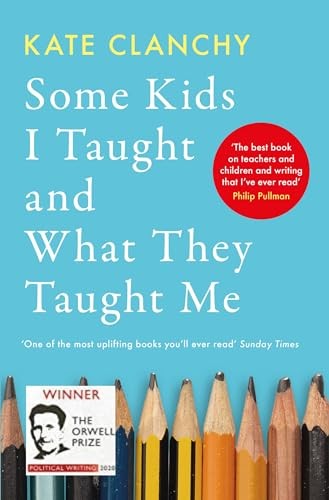
I had been looking forward to hearing the publisher’s perspective on the unhappy saga of Kate Clanchy and her book Some Kids I Taught and What They Taught Me. The book had won the Orwell Prize for non-fiction in 2020 and was described by the judges as ‘moving, funny, full of love and offering sparkling insights into modern British society’.
Then, after a determined and impassioned campaign online, the publisher changed its mind about the book about which it had recently been so proud. It announced that it sympathised with readers who found descriptions in the book, in the words of one of the new critics to emerge, ‘exploitative and reductive, reminiscent of colonial-era pseudo-scientific taxonomies of race’.
The publisher decided not to stand up for its author, and its own editorial decision, siding instead with a group of outraged readers. As the current cliché goes, they threw Clanchy under the bus.
At a moment when she was in a state of suicidal depression – both parents had died during Covid, her marriage had broken down and now she was being accused of doing the very kind of harm which her book had been written to correct – her own publishers joined the pile-on. When she was supported by Sir Philip Pullman, who was at the time the President of the Society of Authors, the Society – the writers’ trades union – joined the fray.
I had followed the controversy online and, as a member of the Society of Authors and a Royal Society of Literature, had witnessed the small earthquake it caused within those two institutions.
But the publisher’s story had never been told. That mattered to me. Over many years I had written children’s books for Pan Macmillan. Some of those involved were people I had worked with as an author. It felt oddly personal. Thank goodness, I thought, there was now a six-part BBC Radio 4 series, Katie Razzall’s Anatomy of a Cancellation, in which my former publisher could set the record straight.
Except it didn’t. Razall got a firm ‘No comment’ from Pan Macmillan: there would be not a single interview in the three hours of radio with an executive or manager or employee of the firm. A bland written semi-apology for ‘a regrettable series of events in Pan Macmillan’s past’ was issues by the company’s new CEO who joined the firm after the Clanchy debacle.
A publishing firm whose business was based on words and communication, declined to offer a word of explanation.
They bottled it.
Kate Clanchy has told the inside story of what happened in an essay headlined ‘The story of a betrayal’ in the latest issue of Prospect and has assiduously been filling in the gaps on her Substack platform. She is clearly a wounded person, and I entirely understand her need to set the record straight (although my advice as an old hand would be now to try to look forward rather than backwards).
What should the rest of us, particularly authors, take away from this sad story of our times? My conclusions are relatively simple:
There are good, kind and intelligent people in publishing – many of them are friends and acquaintances – but somehow a culture of cringe has taken hold of the industry as a whole.
Who knows where this feebleness began? Maybe the process of corporatisation which began in the 1980s has something to do with it. The sacred monsters who had owned and run much of publishing for the previous three decades (Deutsch, Weidenfeld, Hecht, Maschler and others) were making way to a broader, market-led, less individualistic model. Image and PR became dominant concerns – and then the new sensitivity, part of publishing’s profound anxiety about its own privilege, supercharged the whole thing.
For all the positives that came with this process – publishing is possibly less snobbish and marginally less white and middle-class than it once was – one result has been a shift in loyalty away from authors. Public image matters above all else. The idea that a publisher, in commissioning a book, has made a moral and commercial commitment towards that work and its author is for the birds.
The Clanchy saga reveals the process in grim detail. Internal emails, acquired by the author, show that only her editor fought her corner and, when he left, a kind of bullying group-think took hold. A woman at the publisher whom Clanchy thought was representing her case was in fact leading the charge. As the story hotted up, the company’s CEO wrote, ‘I frankly don’t give a toss about Kate Clanchy’.
The pivots and swivels were sometimes in the same week. When the publisher of Picador, the Macmillan imprint that published Kids I Taught, conceded in an interview that Clanchy should have been given ‘more rights’, the reaction online and within the publishers was so infuriated that he had rapidly went into reverse. He wrote on Twitter: ‘I now understand I must use my privileged position as a white middle-class gatekeeper with more awareness to promote diversity, equity, as all UK publishing strives to put right decades of structural inequality.’
The hand-wringing, guilt-ridden angst of the book publishing class could not have been expressed more eloquently.
Not that I was particularly brave. In her recent Prospect piece, Kate Clanchy mentioned that, when her publisher had buckled under pressure, other Pan Macmillan authors wrote to protest. Why hadn’t I done that? At the time. I had assumed that the views of a former author counted for very little. Frankly, who cared what I thought? I clicked and posted on social media a bit but that was frankly the online equivalent of a quiet, discreetly murmured ‘Hear, hear’.
I resigned from the Society of Authors when – astonishingly, scandalously – it actually seemed to encourage the silencing of members who disagreed with the noisy majority on this and other hot issues. I think now I should have been more vocal, less timid.
In these days of culture wars, we all – like those publishers – want to be on the side of the good guys. Sometimes, though, it gets complicated and moral decisions have to be made. On this occasion, the progressive argument led to dishonesty, bullying, and a concerted campaign to silence, shame, de-platform and end the career of a writer of whom they disapproved – wrongly, as it happens They became the bad guys.
My hope is that a new spirit of bravery and loyalty to authors and principles will infect publishing after the Clanchy case. I suspect it will come from small, independent houses rather than from those big, unfriendly giant conglomerates.
And I look forward to more books from the brave, original and interesting Kate Clanchy.